
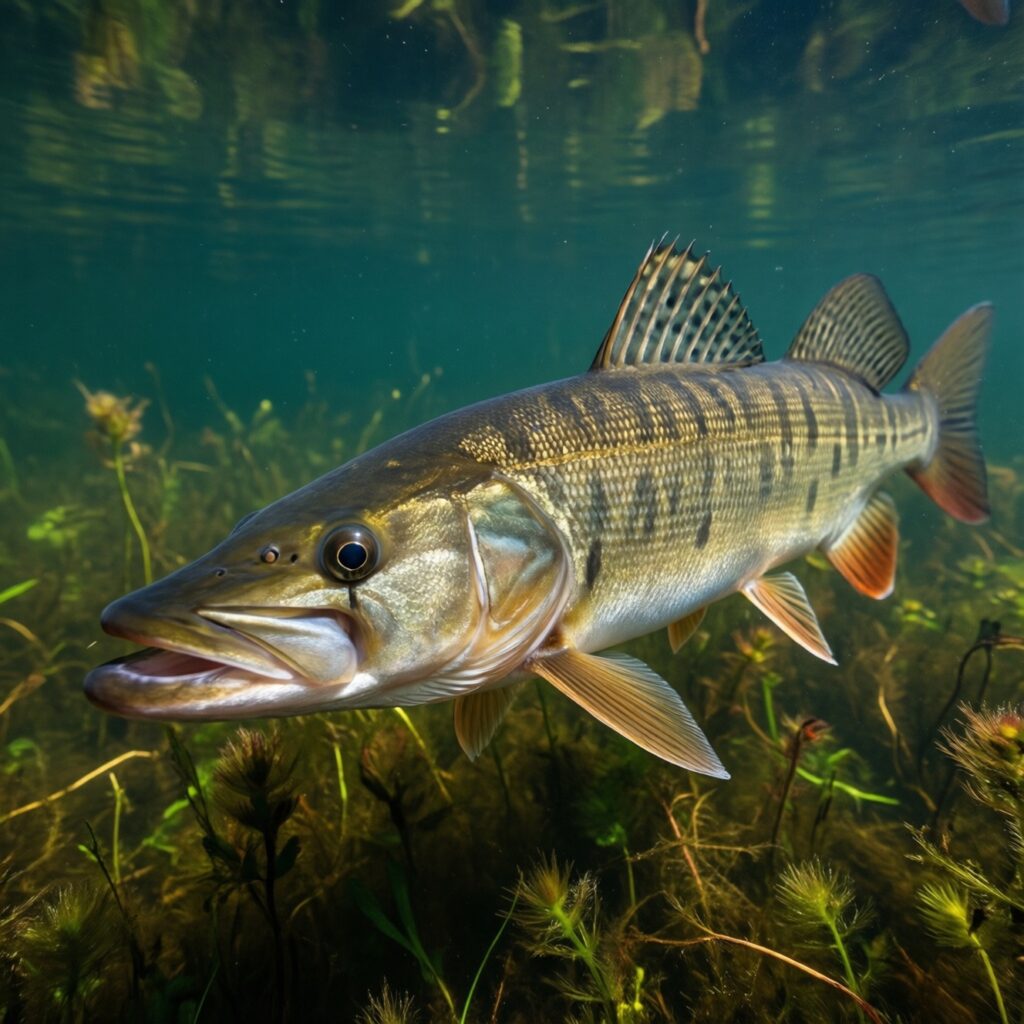
Zander is the English name for Sander lucioperca, a predatory fish also called pike-perch. The name identifies a particular species, not every fish that resembles a perch or pike. For anglers, recognising its features and likely habitat helps guide zander fishing, but feeding patterns and effective methods vary with water conditions and season.
Zander at a Glance: Names, Identity, and Range
- Zander and pike-perch are English names for Sander lucioperca.
- The species belongs to the perch family; its elongated body and prominent canine teeth can help distinguish it from a common perch.
- Zander occur across parts of Europe and western Asia, in freshwater and some brackish waters.
- They prey on fish and often use deeper or low-light areas, though their location changes with conditions.
- Fishing tactics should be adapted to the water, season, and local rules rather than treated as universal.
What «Zander» Means in English
Zander is the standard English common name for the species Sander lucioperca. Pike-perch is another common English name. The phrase «zander fish in English» usually refers to this species and its English names, not to a separate kind of fish.
The word pike-perch describes a fish with features that may remind people of both pike and perch. It does not mean that zander are a hybrid of those fish. Scientific identification relies on the species, rather than on a loose resemblance or a local nickname.
Names can vary between regions and fishing communities. When checking regulations, records, or identification guides, use the scientific name as well as the local common name to reduce confusion.
How to Identify a Zander Among Similar Fish
Use several visible features together. A single feature, such as a predatory body shape, is not enough to confirm identification.
- Check the body shape. Zander have an elongated body, generally more streamlined than the deeper-bodied common perch.
- Look at the mouth and teeth. The mouth is adapted for catching prey, with conspicuous canine teeth among smaller teeth.
- Inspect the fins and markings. The dorsal fins and body pattern can help separate zander from other fish, but colour and contrast may vary with light, habitat, and the individual.
- Compare the overall profile. A zander may appear pike-like in length and perch-like in some fin and body features. Identify the combination, not the impression created by one trait.
- Consider the location, but do not rely on it alone. Habitat can make a zander plausible, but several species may share the same water.
- Use a reliable regional guide when uncertain. If identification affects a catch record or legal decision, confirm it before keeping or reporting the fish.
Where Zander Live and the Habitats They Prefer
Zander are found in parts of Europe and western Asia. They inhabit a range of waters, and local populations may use different areas as water level, temperature, prey, and light conditions change.
- Large lakes: Look for transitions between open water and structure, such as depth changes or areas where prey fish gather.
- Reservoirs: Submerged channels, slopes, and other changes in depth can be useful areas to investigate, especially when baitfish are present.
- Rivers: Search around current breaks, deeper runs, and edges where faster water meets slower water. Fish position can shift with flow and water level.
- Low-visibility water: Zander may feed in water where sight is limited, but turbid conditions do not guarantee that fish will be close to shore or actively feeding.
- Brackish waters: Some populations occupy waters with a degree of salinity. Check local identification and fishing regulations, since conditions and rules differ between locations.
What Zander Eat Through the Seasons
Zander are predators that commonly feed on fish. Their prey and feeding activity depend on what is available locally, as well as on temperature, light, and seasonal changes. Treat seasonal patterns as a starting point for observation, not a fixed calendar.
What this diet can help an angler infer
- When small fish gather along a drop-off or channel edge, check nearby areas where a predator could intercept them.
- If visible prey shifts between shallow and deep water, adjust the search area instead of assuming zander remain at one depth.
- During periods of changing temperature or water level, reassess fish position; feeding locations may change with conditions.
Limits to seasonal assumptions
- A season alone does not establish the fish’s location or activity. Local weather, water conditions, and prey distribution matter.
- Do not assume zander feed only at night. Light conditions can influence activity, but daytime feeding is possible.
- Do not assume one prey type or lure will work everywhere. Match the approach to local forage and the water being fished.
How Zander Behaviour Shapes Practical Fishing Tactics
To work out how to catch zander, start by locating likely fish and prey, then adjust presentation to depth, current, and visibility. Zander fishing is a process of testing and refining, not a guarantee that one time, spot, or lure will always produce a result.
- Myth: zander are always deep. They often use deeper areas, but their position can change as prey and conditions change. Check edges and transitions as well as the deepest water.
- Myth: low light guarantees a bite. Dawn, dusk, or darkness may suit a session, but activity is still affected by local conditions. Plan more than one time or depth to test.
- Common error: fishing one depth for too long. If there is no sign of prey or fish, change depth or location methodically rather than repeating the same presentation.
- Common error: choosing tackle by species name alone. Zander fishing tackle should suit the depth, current, lure or bait, and local rules. A river and a stillwater may call for different setups.
- Common error: treating one bait as universally best. The best bait for zander depends on what is permitted and what prey is available. Compare suitable options under the conditions you actually have.
Scenario: At a reservoir with no visible surface activity, begin by checking a depth change and nearby baitfish signs. If the first presentation produces no contact, alter the depth or move along the feature before concluding that the area is empty.
Scenario: On a river with noticeable flow, look for a position where fish can hold outside the strongest current. Choose an approach that can be presented controllably there, and reassess if water level or flow changes.
Field Checklist for Recognising and Targeting Zander
Use this short sequence to connect identification with a practical fishing decision:
- Check that the fish’s body, mouth, teeth, and fins fit zander rather than relying on colour alone.
- Confirm the species with a regional guide if identification is uncertain or legally important.
- Choose a likely area based on habitat, depth changes, current, and signs of prey.
- Match your tackle and presentation to the water and permitted methods; change one factor at a time if conditions give no response.
- Have I confirmed the fish’s identity rather than guessed from its silhouette?
- Have I checked local regulations and any restrictions on bait or tackle?
- Am I testing a plausible location and depth, or repeating an unproductive approach?
Zander Name and Fishing Queries, Clarified
What does «zander fish in English» mean?
It refers to the fish called zander in English, scientifically named Sander lucioperca. Pike-perch is another English common name.
Is zander the same fish as pike-perch?
Yes. Zander and pike-perch are common names for the same species. The scientific name helps clarify the identity when common names differ by region.
How can I tell a zander from a common perch?
Compare the overall body shape, mouth, teeth, fins, and markings together. Zander are generally more elongated and have prominent canine teeth; confirm uncertain identifications with a regional guide.
Where should I look for zander?
Search likely features such as depth transitions, deeper river runs, current breaks, or areas where prey fish gather. Their position varies with water conditions and local prey.
What is the best bait for zander?
There is no universally best option. Choose a legal bait or lure that suits local forage, depth, current, and visibility, then adjust based on what the water tells you.
What zander fishing tackle should I use?
Use tackle suited to the method, water, depth, and current rather than relying on a species-specific formula. Check local rules before choosing bait, lures, or equipment.
Are zander only active at night?
No. Light conditions may influence feeding, but activity is not limited to nighttime. Test different times and locations in response to local conditions.