
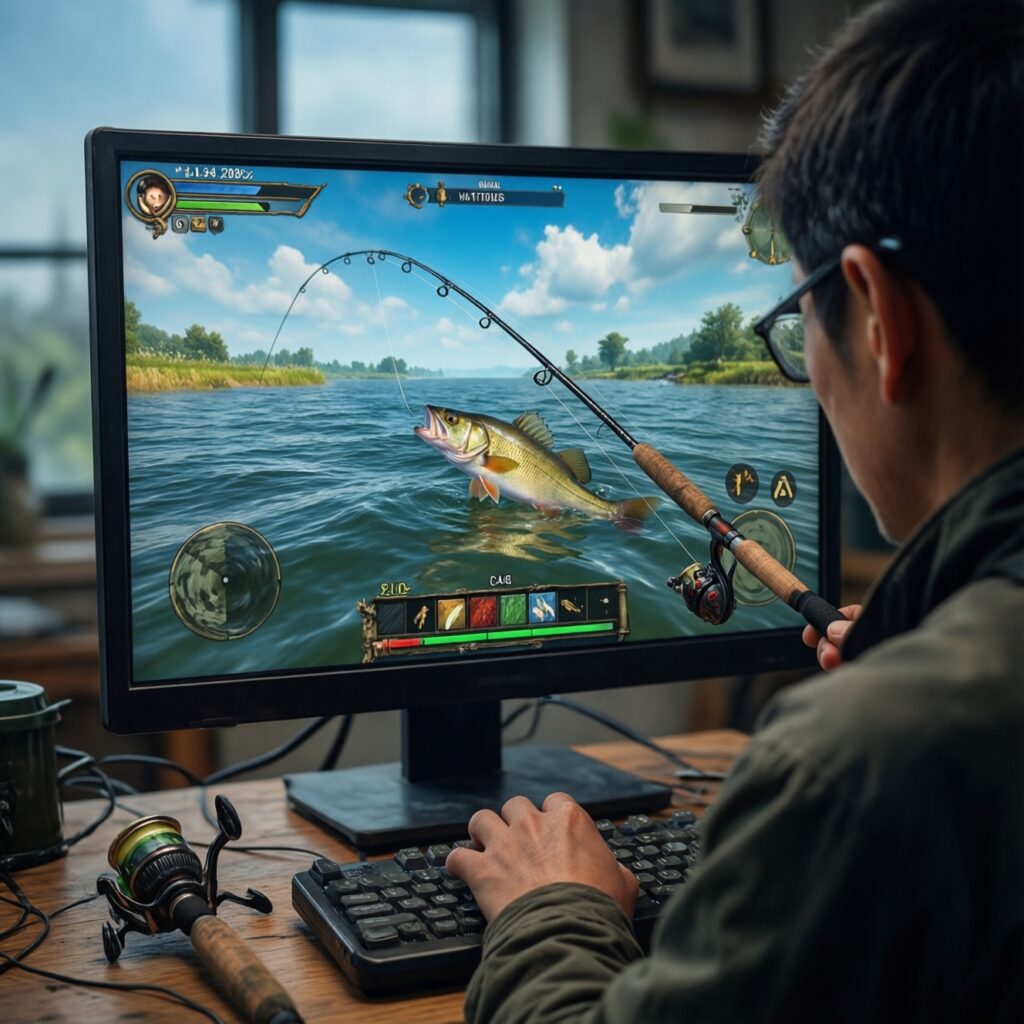
Russian Fishing 3 is a fishing simulator in which success depends on more than casting and waiting. Your tackle, bait, fishing method, and the conditions in the game all affect what you can catch. If you are new, approach it as a game of learning systems: make one change at a time, observe the result, and avoid spending resources on equipment you do not yet understand.
Start with the basics
Begin with the game’s introductory information and available starter equipment. Learn how to select a rod, assemble its tackle, choose bait, cast, and retrieve or manage a waiting setup. Interface details and available options can change with updates, so use the labels and help shown in your own game rather than relying on an old screenshot as an exact match.
Before a session, check that the setup is complete and suited to the method you intend to use. A rod alone is not a fishing setup: the reel, line, hook or other terminal tackle, and bait must work together. If the game presents warnings or shows that a component is missing, resolve that before casting.
Build a balanced setup
Beginners often focus on buying the strongest-looking item. Instead, think about the whole setup. A line that is too weak for the intended catch may fail under pressure; equipment that is unnecessarily heavy or costly can consume money without solving the actual problem. Match tackle to the kind of fishing you are attempting, and read each item’s displayed specifications carefully.
- Choose a method first. Decide whether you are using a float, bottom, spinning, or another method supported by your current equipment and the game.
- Use compatible parts. Check rod and reel requirements, line capacity, and any limits or recommendations shown in the interface.
- Keep bait purposeful. Select bait appropriate to the method and target you are testing, rather than changing several bait types at once.
- Protect your funds. Keep some in-game currency available for essentials and repairs or other costs that the game may apply.
Learn from each fishing session
A quiet stretch does not automatically mean your equipment is broken. The target fish may not be responding to that bait, the chosen method may not suit the situation, or the conditions may be unfavorable. Treat each attempt as a small test. Record or remember the location, time, method, bait, and result. Change one variable, then compare what happens.
When you get a bite, follow the game’s prompts and manage the fish rather than assuming that rapid input is always best. Pay attention to tension, drag, and any indication that the line or tackle is under strain. If a fish escapes or equipment fails, inspect the setup and identify the likely cause before repeating the same approach. The exact controls and indicators are game-specific; learn them in a low-risk situation before trying to land a valuable catch.
Understand progression and spending
Progression systems in fishing simulators can connect catches, experience, skills, equipment, and access to new options. Check the in-game menus to see what actions advance your character and what an upgrade actually changes. An expensive rod is not necessarily the best next purchase if your current limitation is a weak line, an unsuitable reel, or an unfamiliar fishing method.
Set a modest goal for each session: learn one control, catch a fish with a particular setup, or understand one equipment statistic. This makes early play more useful than chasing a large catch before you know how to manage it. Avoid spending all your funds on a single upgrade unless you understand how it fits the rest of your tackle.
How to evaluate a Russian Fishing 3 guide
Guides can save time, but their advice may reflect a specific game version, progression level, or play style. A useful guide explains its reasoning and gives enough context for you to reproduce the approach. Be cautious of short claims that a setup is universally best, especially if they omit the target, method, equipment level, or conditions.
- Check the date and version context. Updates can change menus, balance, or equipment. Confirm that the guide resembles the game you are playing.
- Look for a complete setup. Good advice identifies the method and relevant tackle and bait, rather than naming only one item.
- Prefer explanations over promises. A guide should explain why a choice may work and what to change if it does not.
- Separate observation from certainty. A player’s successful session is evidence of what worked for them, not proof that the same result is guaranteed.
- Verify risky advice in-game. Check prices, requirements, controls, and restrictions in your own menus before committing resources.
Be especially careful with guides that present precise coordinates, guaranteed catches, or current prices without showing when and how they were checked. Such details may become outdated or depend on circumstances the guide does not explain. You do not need exact claims to learn the core skill: test a coherent setup, watch the result, and adjust methodically.
Keep game advice distinct from real fishing
Russian Fishing 3 models fishing for play. Its equipment statistics, bite behavior, progression, and locations are governed by the game, not by real-world fishing regulations or biological guarantees. Use in-game instructions for game mechanics. For fishing outside the game, consult local rules and practical safety guidance instead of treating a simulator guide as real-world instruction.
The most reliable beginner strategy is simple: understand your controls, assemble compatible tackle, make small experiments, and spend gradually. With that foundation, guides become easier to evaluate—and you can tell whether their advice teaches a transferable method or merely describes one player’s particular result.